
route.fast
route.fast uses an on-device LLM to detect, reason and mitigate threats — from DDoS to BGP hijacks — while authenticating every intent with LIP-4D and logging human-readable explanations.
route.fast evolves in two tracks: the Community Edition for open innovation and the Enterprise / Defence Edition for sovereign, mission-critical networks.
Fighting AI with AI — the foundation of an adaptive and self-healing Internet.
route.fast is an AI-powered, agentic router that blends proven Linux routing (FRR/BIRD/GoBGP), high-speed telemetry (eBPF, NetFlow, Suricata/Zeek), and a local LLM “brain” trained to reason about threats and intent. It explains every action in plain language, enforces policies through LIP-4D, and coordinates with peers via a secure, human-auditable intent protocol.
route.fast unites open innovation with Defence-grade resilience.
Open-source (Apache-2.0) core router with explainable AI and LIP-4D intent policy engine. Ideal for ISPs, research labs and ethical hackers.
Commercial and sovereign version with advanced threat intelligence, compliance audit, and certified secure control for Defence and national infrastructure.
Both editions share the same ethical AI framework, explainable actions, and continuous collaboration between human and machine reasoning.
On-device LLM interprets telemetry and proposes mitigations in strict JSON with clear explanations.
Routers negotiate signed intents in an AI-native language to prevent collateral damage.
Identity, authorization, context and time checks authorize every change before it reaches the control plane.
FlowSpec, BGP policy, ACLs and VRF/VLAN segmentation — interoperable, standard control.
Every action is logged with rationale and evidence digests to accelerate audits and incident response.
Community Edition (Apache-2.0) + Enterprise for LIP-4D server, multi-tenant control and compliance reports.
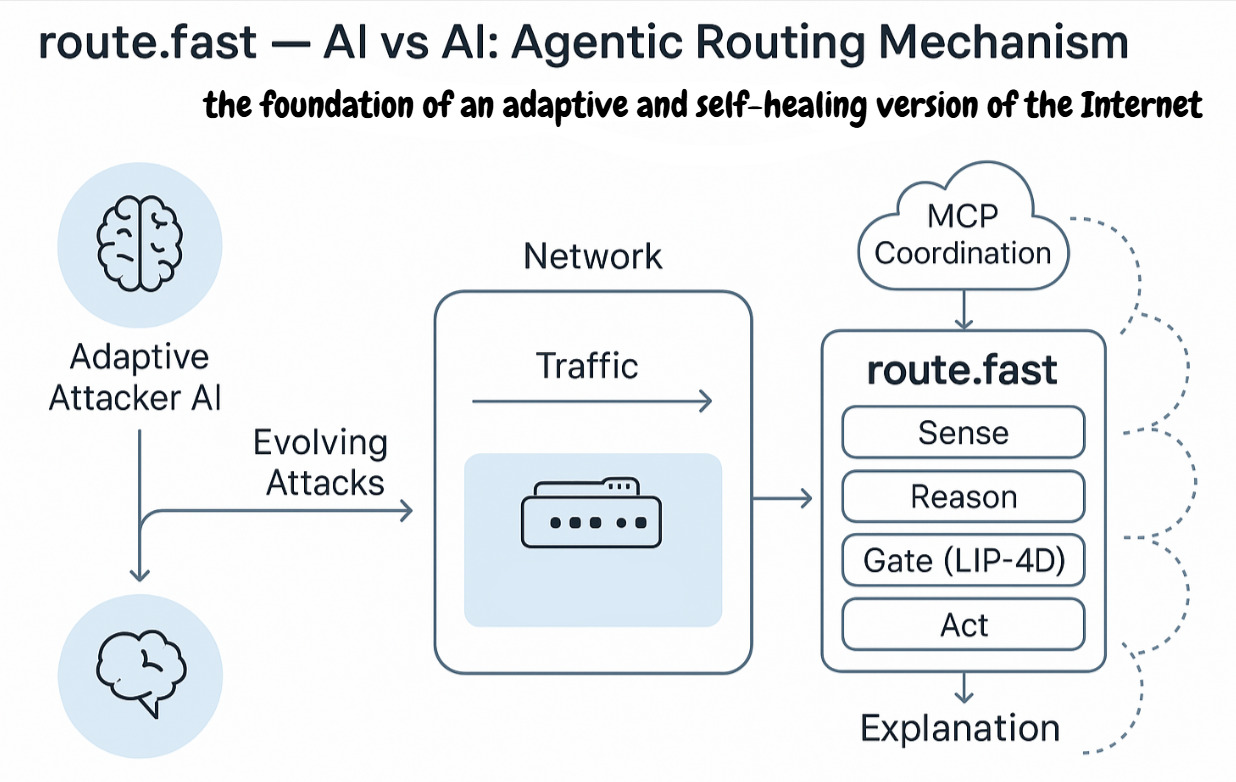
eBPF, NetFlow/sFlow and Suricata/Zeek provide high-fidelity signals.
The LLM evaluates evidence against policy and returns a structured action + explanation.
LIP-4D validates identity, authorization, context and TTL before any change is allowed.
FRR/ExaBGP/nftables apply standards-based mitigations (FlowSpec, localpref, ACLs, segmentation).
Every action is recorded with a human-readable rationale and evidence digest.
Peers exchange signed intents to share load and prevent cascading failures.
route.fast is developed in Wales by AOvidi Ltd (UK) — innovators behind the LIP-4D intent protocol and pioneers of AI-driven networking. The project’s Defence-grade pathway builds on over 30 years of cybersecurity and cloud-infrastructure expertise, including UK nuclear research collaborations and ethical AI validation projects.
Your backing funds the open-source Community Edition, the LIP-4D Policy Engine, model specialization and pilot deployments with ISPs and edge operators — accelerating a safer, explainable Internet.
In parallel, AOvidi Ltd is developing an Enterprise Edition designed for large-scale, regulated, and sovereign deployments, including national security and critical-infrastructure environments. This edition focuses on centralized LIP-4D services, multi-tenant governance, and compliance tooling, and is aligned with UK Defence innovation programmes and relevant MOD standards — ensuring that open innovation and defence assurance evolve together.
| Capability / Aspect | Community Edition | Enterprise Edition |
|---|---|---|
| License | Apache-2.0 | Commercial |
| Core routing engine | ✓ | ✓ |
| Intent4D model | ✓ | ✓ |
| LIP-4D protocol semantics | ✓ | ✓ |
| Local intent validation (Gate) | ✓ | ✓ |
| Single-node / single-tenant | ✓ | ✓ |
| JSON Schemas & RFCs | ✓ | ✓ |
| Central LIP-4D server | — | ✓ |
| Cross-node coordination | — | ✓ |
| Multi-tenant governance | — | ✓ |
| Rules of Engagement orchestration | — | ✓ |
| Compliance & audit exports | — | ✓ |
| Defence / sovereign governance | — | ✓ |
No. route.fast reasons over metadata only. Data-plane forwarding remains in kernel/ASIC.
Actions use standard interfaces with rate-limits, circuit-breakers and rollback.
Yes. Community Edition is Apache-2.0. Enterprise adds LIP-4D server, multi-tenant control and compliance exports.